For a long time, I’ve been warning about the seemingly unstoppable expansion of Islam throughout much of the world—in Africa and the Middle East, in Europe and Asia, in South America and to a lesser extent in North America.
At the same time Islam is beginning to show unmistakable signs of weakness and vulnerability. According to the Times of London, the Supreme Leader of the Islamic Republic of Iran, Ayatollah Ali Khamenei has plans to escape to Moscow with his family if the current nationwide protests continue to intensify.
Such protests have occurred in the past, but they have always been put down by means of mass killings and mass imprisonment. This time, however, may be different. President Donald Trump warned the regime not to kill protestors, or the U.S. would attack Iran again as it did last June when stealth bombers destroyed three Iranian nuclear facilities.
Khamenei must have realized that this was no idle threat. Trump had warned the Nigerian government that the killing and abduction of Christians must stop, and when it didn’t, he followed through with devastating airstrikes against ISIS terrorists in Northern Nigeria. Then, on January 3,2026 the U.S. military abducted and arrested Nicholas Maduro the president of Venezuela and charged him with various serious crimes.
According to the Times, Khamenei’s bags are already packed. It doesn’t take much brain power to realize that if Maduro, who commanded the most powerful military in South America, could be snatched from his home and flown to an American Warship in less than an hour, the same could be done to the Supreme Leader of the already weakened Islamic Republic of Iran.
Khamenei would be well-advised to leave. Just as the majority of Venezuelans celebrated the departure of Maduro, the majority of Iranians would be happy to see Khamenei gone (or else in prison.) If the Ayatollah should flee Iran, it’s quite possible that his government would collapse. The protests have spread to more than 100 Iranian cities, some protestors chant for the death of the Islamic Republic, others call for the return of Crown Prince Reza Pahlavi, the son of the ousted Shah. In some cities police have joined the protestors.
Of course, it’s possible that the regime will put down the protests the way it put down the 2022 uprising when nearly 600 protestors were killed.
On the other hand, things are different this time. Iran has been severely weakened by crushing blows from Israel and America. And now President Trump is warning of more devastating attacks on the regime should protestors be killed. Under the present circumstances, Iran’s theocratic regime could fall with surprising speed.
Surprising speed? Yes, although Rome didn’t fall in a day, there are several past examples of kingdoms, empires and great powers that did fall in a relatively short time. The most recent example is the collapse of communism in Eastern Europe and then in the Soviet Union. Until the Berlin Wall fell, very few expected such rapid changes in so short a time.
Can it happen again? Are other powers poised to topple? According to Florida Representative Carlos Gimenez, it already is happening. After the stunning capture of Nicholas Maduro, he wrote: “Today’s decisive action is this hemisphere’s equivalent to the Fall of the Berlin Wall.” In other words, the American strike could be the beginning of the end of communist power and influence in South and Central America.
That might seem a long row to hoe, but the decapitation of the Venezuelan regime has already had significant repercussions, most notably in Iran which has numerous economic, political, and military ties with Venezuela.
The military ties include the transfer of high-ranking officers and personnel, and the development of drones and other weapons that could be used to strike targets inside the United States. At the same time, the Iran- financed terrorist group Hezbollah was able to establish a strong beachhead in Venezuela which has allowed it to penetrate other Latin American countries. All of this once secure alliance is now in jeopardy.
Meanwhile, in Iran itself another Berlin Wall is beginning to crumble. It’s made up of fanatical and oppressive religious doctrines backed by police batons and automatic weapons. And the Iranian people have been trapped inside this wall for nearly four decades. One could call it the “Tehran Wall”, but I prefer the “Islamic Wall” because there’s a good chance that the uprising against it will spread to other Islamic countries. This is what happened after the fall of the Ottoman Empire following the defeat of the Ottoman Turks in World War One. The new leader of the Turks, Kemal Ataturk re- established Turkey as a secular state in which the imams and other religious leaders were kept firmly in check.
The Westernized, secularized society that Ataturk created in Turkey soon became the model for other Islamic countries—for Iran, Iraq, Egypt and elsewhere. Writing of the 1950’s Ali Alawi, a former Iraqi cabinet minister observed “It appeared to be only a matter of time before Islam would lose whatever hold it still had on the Muslim World.”
But in 1979, Islam regained its iron grip on Iran, and the hijab which had long been out of style became mandatory. Those who wouldn’t go along with the new order were either killed or imprisoned. Now, however, the people of Iran are rebelling against the rule of the Mullahs, and an important question needs to be asked: What do they hope to replace it with—a more moderate form of Islam? Christianity? Secularism?
Judging by current demographics, Christianity seems to be out of the question. Although one hears about many cases of conversion to Christianity following a mystical encounter with Jesus, the Christian percentage of the Iranian population still seems to hover around 1.5 percent (keep in mind, however, that accurate statistics about religious identity in Iran are hard to come by). The Christian population, in turn, is split between evangelical Protestants and Catholics. For reasons that will be explained shortly, mass conversions to Christianity seem unlikely.
Might Iranians be hoping for a more moderate form of Islam to replace the repressive version that controls them? Again, that seems unlikely. A recent online survey that guaranteed anonymity found that only 40 percent of Iranians identify as Muslims, while 9 percent identified as atheists, 7 percent as “spiritual” and 8 percent as Zoroastrians. Moreover, of the 40 percent who do identify as Muslims, 10 percent do not believe in one of the central tenets of Islam—namely, the existence of paradise and hell. Muslims seem as likely to become atheists or Zoroastrians as to become moderate Muslims.
In short, Iran is no longer a majority-Muslim country. Christians, particularly Catholic Christians, do not appreciate how little respect Iranians have for Islam. At this point, indeed, a great many Iranians have developed a deep hatred for Islam. This hatred is revealed in the burning down of dozens of mosques, and in the chants which call specifically for an end to the Islamic regime and for the death of Khamenei. Iranians have come to look at the religion of Islam as the source of their oppression and misery.
Unfortunately, for many Iranians religion itself has become suspect. This may help to explain why Christianity has not been as successful as one might expect in making conversions.
The Catholic Church, in particular, has identified itself so closely with Islam, that Iranians can be forgiven if they hesitate to trust the Church. Ever since Vatican II the Church has done nothing but extoll the virtues of Islam and its supposed commonalities with Catholicism. And for decades the Church has remained largely silent about the persecution of Christians by Muslims.
At the same time, the Church acted as a booster of Iran’s theocratic government. Cardinal Theodore McCarrick, for instance, was one of the chief proponents of the disastrous Iran nuclear deal. He traveled to Iran on several occasions and reassured Americans that the Iranians could be trusted because the Ayatollah had issued a fatwah to the effect that Iran’s nuclear program would only be used for peaceful purposes.
Another reason to suspect that Iranians (and other Muslims) will not be converted to Catholicism is because Pope Francis assured Catholics that Muslims didn’t need to be converted since their religion is basically the same as our religion. If conversion is unnecessary and unimportant, as Francis seemed to believe, very few Catholics will be willing to undertake the difficult task of bringing Muslims to Christ.
Many Muslims throughout the world share the Iranians lack of faith in Islam; consequently, the current uprising in Iran might well spark a chain of events that leads to a widespread rejection of Islam. Muslims deserve to know that what they’re looking for can be found in Christianity. But it’s important for Christians to realize that what Muslims are looking for can’t be found in the let’s pretend fantasy that we should be friends because we all worship the same God and we all love Jesus and Mary. Rather, the goodness and truth of Christianity is to be found in listening to the word of God and reading it in the Gospels.
If you appreciate this analysis, please consider making a donation to Turning Point Project. Thank you.
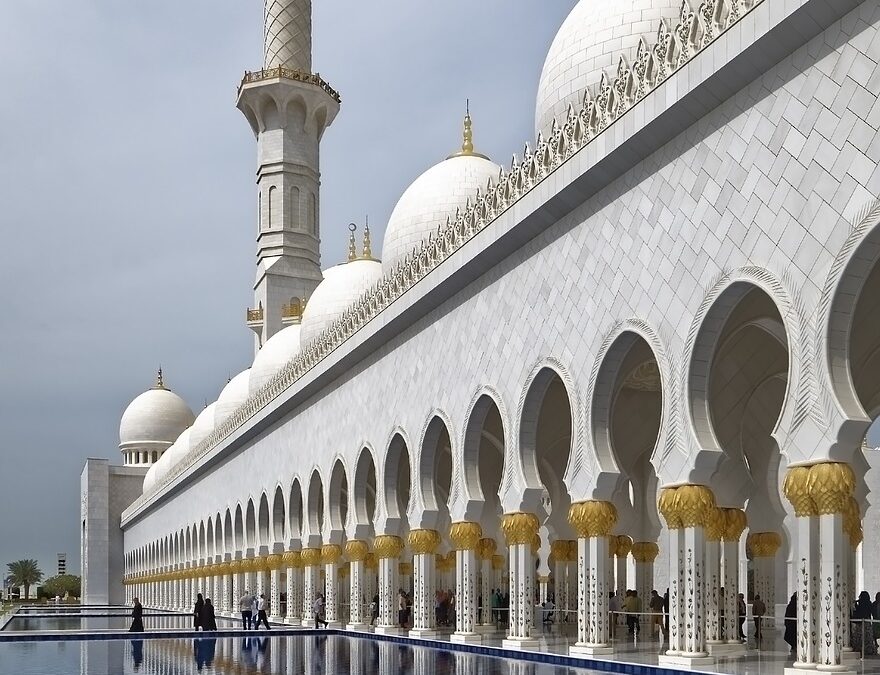
Pictured above: Grand Mosque, Abu Dhabi
Photo credit: Pixabay